RUN IT BACK!
Don't take it laying down, RUN IT BACK!
roles and responsibilities
Art
Co-Producer
Programmer
Developer(s): Perfect Guard
Team Size: 5
Tool(s): Unreal Engine 5, Aseprite, Microsoft Suite
OVERVIEW
Run It Back is a 2.5D 1v1 fighting game! Play as supervillains in a brawl to see who the greatest villain is. These villains are sore losers though, and get stronger with every round loss - giving them access to a whole slew of new abilities.
Don't let them one up you...RUN IT BACK!
Run It Back features 2 characters with their own unique robust movesets, hand drawn animations and voice lines! Created as a capstone project during my 4th and Final Year at Sheridan College.
Run It Back serves as a love letter to the fighting game genre I fell in love in with back when I was a kid. It also serves as my attempt to showcase higher level system design, combat focused art, and a greater understanding of programming and UE5 scripting.

Gameplay SHowcase

The core pillars of Run It Back was something the team followed when working on anything related to this project. It was important as Co-Producers to check in and make sure everything we talked about among us was conveyed properly with the rest of the team in relation to these pillars.
Phases were the core hook of our game and we made sure it was our prime focus, from creating characters to balancing, creating moves and UI/UX to signify this to players!
Making a solid Fighting Game on top of our gimmick was our next priority, we didn't want to reinvent the wheel but keep our sights on why we fell in love with fighting games to begin with!
Finally was our thematic of Supervillains, it kept art direction, narrative and stage design focused. It also made team conversations about our favourite fictional villains a premiere discussion starter.
The PHASE MECHANIC
The core system of Run It Back is our Phase System. This gameplay mechanic sees the player gaining new moves and stronger stats after losing a round. Taking inspiration from other fighting games, come back mechanics aren't new, but the timing of when these bonuses apply is the biggest difference in our system.
Spawning from previous games the biggest point of contention for some fighting game fans is the fact comeback mechanic applies mid round. Transforming a lead into a wipe with a single mistake due to the nature of comeback mechanics. So we chose to move the application of these bonuses till AFTER a round loss to ensure a lead was still confirmed.


Thematics
The theme of Run It Back has always featured the vision of comic book Supervillains. The inspiration from games were clear, but the villainy theme was important for several reasons.
It fed into the idea of doing anything to win, using underhanded methods to win, and feeding into player perception of fighting other players. A villain doing attacks that confuse or overpower your opponent thematically disconnected players' empathy, which was the intention.
Comic book villains are also no strangers to refusing to stay down for long, being sore losers and coming back is a staple for any good villain.
Engine Work


Run It Back was a large technical challenge due to the complex nature of fighting games, which involved a deeper understanding of UE5, node-based design and documentation.
The focus for most of Run It Back's complex development was the State Creation, using multiple blueprints and node-based design for both our characters.
The states made are reflective of each action and reaction that either fighter could be found in; states needed to be modular ahead of time for easy hotfixes and future balancing.
HITBOXES

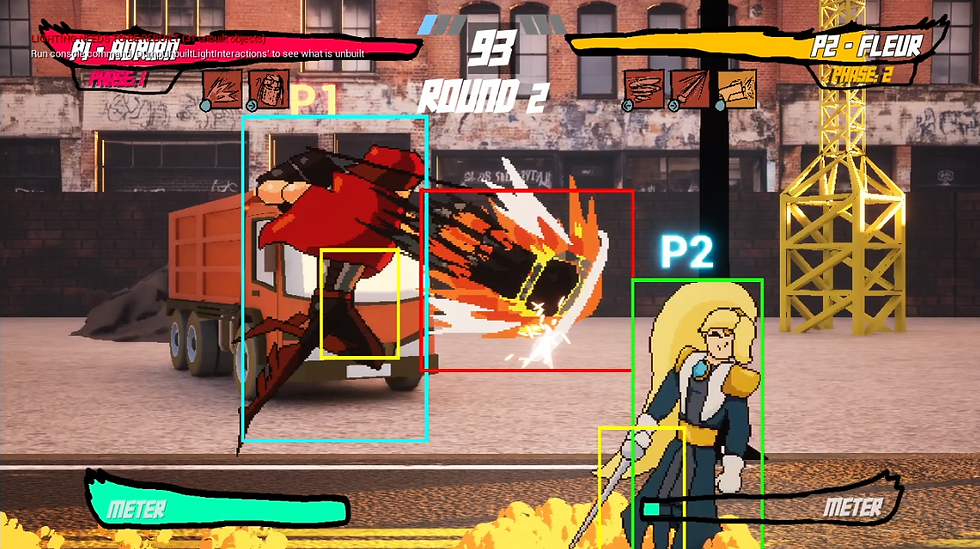

During the process of making all the states for each character, it was important that all the data from the states could be properly applied in-game on each frame, so in came Hitboxes.
A staple in any fighting game development, but regardless of their commonality, it is important that the hitboxes are applied properly and readjusted constantly.
While the hitboxes were modular, it became a source of contention when attempting to balance moves when figuring out any bugs, such as infinites, chain links and combo routes.
RUSHDOWN CREATION


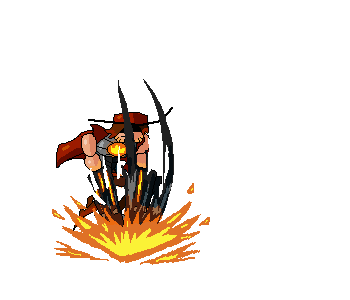
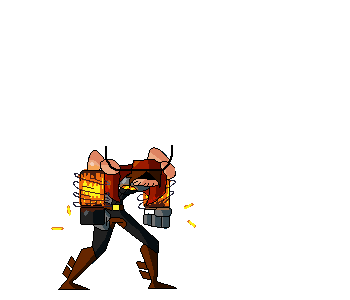
Some behind the scenes in regards to our second character, Adrian Burns, internally referred to as Rushdown. He started off as 1 of our 4 main characters, we originally wanted to create 4 to represent each major archetype of a fighting game character, Shoto, Rushdown, Zoner, Grappler, however complications came up very quickly.
Instead design energy was hard focused on expanding Shoto and Rushdown past their original smaller scoped designs. I am the primary creator of the Rushdown, starting off design work through thought trees and breaking down other examples. I also had to keep in mind our phase mechanic to add more thematic depth that matches his expanding movesets.
After conversing with my Co-Producer, Jamie Canney, I was able to land on a thematic more geared towards a combination of a cyborg mixed with a bounty hunter, fitting the visuals of evolving gameplay and villainy more akin to Taskmaster or Boba Fett. With that I went back to design work, then a ridiculous amount of animation and finally in-engine creation of Adrian Burns.
RUN IT BACK
TECH DEMO
early
concept Pitch

RUSHDOWN SPRITE ART